I argued before to look at realistic billable hours, but this article contains for the first time a clear elaboration based on a new idea of working with discs. And classifying professions in the process.
The self-employment law may have been shelved by the new cabinet, but that does not mean there is still talk of minimum rates for self-employed people. Such a minimum amount (by 2026 it will be 38 euros per hour) sets the limit below which the self-employed person would probably have to be employed. But such an amount does not work fairly for all the different types of self-employed workers. It makes quite a difference whether you can bill an average of 18 hours or 28 hours a week in the sector you work in.
Earlier, I wrote this article about it: Subsistence security for self-employed: why minimum rates per sector are needed
Differences between self-employed professions are large
Professions differ greatly in billable hours. And those hours are very important for a self-employed person. Because that's what you base an hourly rate on. You can read how these hours matter in this article: Fair payment for self-employed in culture impossible without solid research on billable hours
Every market has different market averages and, as an entrepreneur, you need to take this into account. A realistic view of billable hours ensures that you are able to set a rate that can lead to a sustainable income.
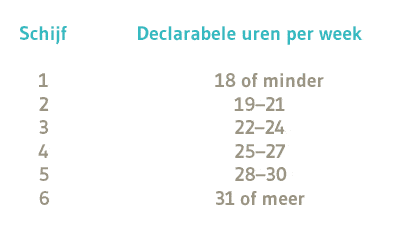
So I have a new proposal: work with slices and classify professions by slice, based on realistic billable hours of market averages. That way, you can set a lower limit in line with the economic reality of a sector.
Customisation agreements are not new
I sometimes hear that people don't want imposed rates for self-employed people. And I agree with that if market forces work well. As long as the prevailing rates provide an income that a self-employed person can make ends meet. And that's the problem, because it doesn't always do that: Market forces: why they no longer work well in some sectors
That is why I advocate a lower limit. Many self-employed people will not have to deal with this, because a lawyer really does keep working for a healthy rate. But for some self-employed people, a lower limit in a law is better. That way, regardless of the sector, working can result in an amount at least equal to a minimum income of someone employed.
I see in the creative sector how pricing is under pressure. A rate should primarily be determined by an independent entrepreneur himself and should provide an income you can live on. The difference between theoretical entrepreneurial freedom and actual negotiating power is sometimes big. Still, the basis should be a healthy rate. To ensure this, I try to come up with concrete proposals that also look at the reality that self-employed entrepreneurs face.
The current situation
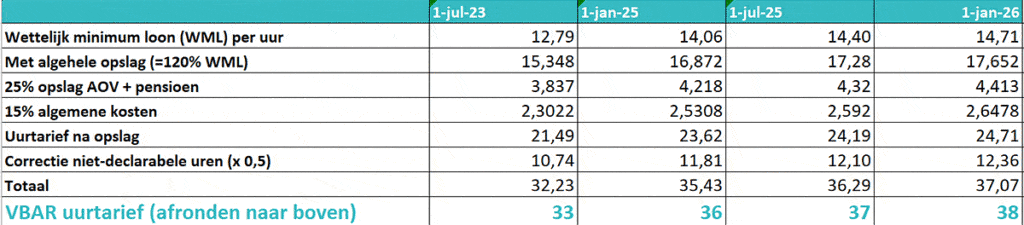
The current vbar/self-employment law assumes a lower limit of 38 euros. It was created that way:
Adjusting that fixed data for non-declarable hours by sector results in very different amounts. The current calculation assumes a correction of +50%, so 2/3 billable and 1/3 non-declarable. But that is certainly on the high side in the creative sector.
If you divide occupations by tranche based on average billable hours, it might look like this:
If you start calculating for each bracket what a realistic lower limit should be based on realistic billable hours, this is what you end up with:
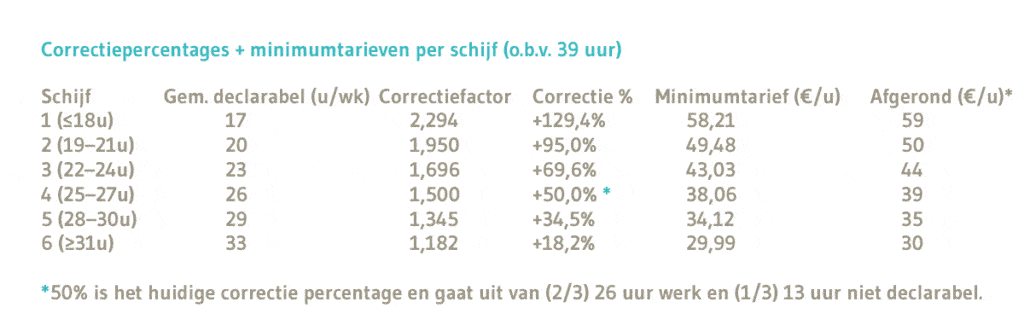
So, for example, if you work in a sector where an average of 23 hours per week is billable (like journalism, for example), the lower limit should be around 43 euros. In creative sectors, you can often work even fewer hours. Check out the KNAB's schedule of billable hours on this page: https://www.reclamebeeld.nl/zzp-sectorale-rechtsvermoeden-van-minimumtarief-naar-maatwerk/
The current fixed lower limit of 38 euros per hour does not do justice to the differences between sectors. Those based on realistic billable hours arrive at different amounts in many professions.
Sector-specific look at reality
If we introduce a legal presumption of salaried employment, it is better to look at sectors separately. Because with the current lower limit, you don't guarantee anyone a livable income. Because as a good self-employed entrepreneur, you still have to add a lot of value. Moreover, you would rather not work for lower limit amounts that end up at a minimum, just as someone in salaried employment would rather not work for a minimum wage.
But a sector-specific amount can become a lower limit that offers some protection in sectors that are under too much pressure. I hope the central government will take up my discs idea because that way you can put a lower limit in sectors where the self-employed have more to gain.




 Nederlands
  English (UK)
  Français