Amsterdam Museum's latest exhibition at H'ART Museum
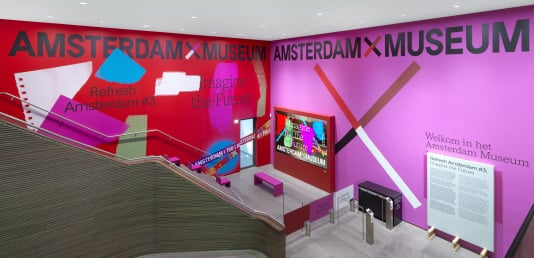
The high-profile exhibition Refresh Amsterdam #3: Imagine the Future is entering its final weeks. Until 30 November, you can see how contemporary artists and the general public envision the future. It is also the Amsterdam Museum's last exhibition in the H'ART Museum building at 51 Amstel.
“This exhibition offers a huge broadening of the view of the future. Because there is still a lot to do,” concluded Bart Rutten, director of Centraal Museum Utrecht, during his visit to Refresh Amsterdam #3 as presenter of the television programme Now to SEE!. Media such as NRC, Never Sleep Again, NPO Radio 1, De Volkskrant and The Parool paid attention to the exhibition, which, according to the latter newspaper, shows that ‘optimism in the world is far from extinguished. For a few more weeks, until 30 November, visitors can see for themselves this edition of the biennial art event. No fewer than 15 contemporary artists reflect on possible scenarios for Amsterdam's future, along themes such as climate, urban development, inclusivity, technology and social connectedness. The general public, including schoolchildren and students, also shared dreams, wishes and expectations for the future. These wishes were submitted from all over the country, following a nationwide call and visits to all provinces.
Distinction for Raquel van Haver
As far as the Amsterdam Museum is concerned, the very uncertain times we live in call for dialogue: how can we do things differently? This is also a relevant question for visual artist Raquel van Haver (1989, Colombia). Her solo presentation The Collateral Kin (The kinship) is central to Refresh Amsterdam #3 and thus forms the first chapter of the exhibition, which is made up of four chapters. With her six monumental group portraits, she pays tribute to Amsterdam social players active in recent decades, including anthropologist Prof Gloria Wekker, writer Massih Hutak and poet Diana Ozon. They are sometimes familiar names, and sometimes people who play a role in the background. All contribute to the Amsterdam of today and tomorrow. The large, lively paintings are, as it were, a contemporary interpretation of the regent and bailiff paintings of the seventeenth and eighteenth centuries.
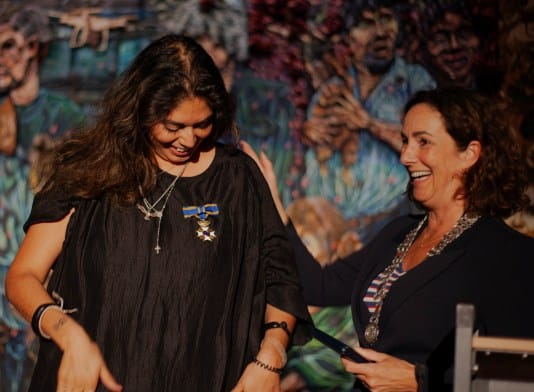
For her impressive artistry and works of great social value, Raquel van Haver was appointed Knight of the Order of the Dutch Lion on 30 October. Among her works of art at the museum, Van Haver received the award from the hands of Amsterdam mayor Femke Halsema. In her speech, the mayor called Van Haver ‘a bridge between culture generations and continents, between the studios of Southeast and the markets of Bogota. Between the energy of the street and the silence of the museum. (...) Her art reaches beyond the canvas and beyond the walls of museums. She reaches our society.’
The Amsterdam Museum is hosting a symposium on 16 November, where several speakers will share their views on the future of Amsterdam. And on 28 November, the AM Late place: a lavish evening programme in the exhibition.
End of programming at H'ART Museum
Refresh Amsterdam #3 is the most comprehensive exhibition the Amsterdam Museum has made at the H'ART Museum - and also the last. Back in 2014, the Amsterdam Museum presented in a wing of this museum building on the Amstel River Group portraits of the 17th century, a semi-permanent exhibition featuring seventeenth- and eighteenth-century group portraits from the Amsterdam Museum and Rijksmuseum collections. From 2022, the Amsterdam Museum even established its temporary main location there, with the collection presentation Panorama Amsterdam: a living history of the city, 15 temporary exhibitions, an extensive public programme, educational programming, and many pop-up presentations in collaboration with communities in the city.
The lease expires on 1 January 2026 - the Amsterdam Museum chooses not to renew it.
“At the end of 2024, the green light for the renovation of the Civic Orphanage finally came through, following the positive decision of the Council of State. From then on, we could fully focus on the work for the new Amsterdam Museum,” explains Judikje Kiers, director of the Amsterdam Museum. “In addition - on the way to the new museum - we continue to develop content. In H'ART Museum, we were able to experiment with various forms of presentation for 3.5 years. Now we see an opportunity as a network museum to go even deeper into the capillaries of the city and expand our expertise in that area too.”
Programming in the city as a network museum
In the run-up to the reopening of the Burgerweeshuis, the Amsterdam Museum will programme at various locations in the city. Collaborations with various partners and networks are also planned. “We continue to question and explore what the function of a museum can be in these times. Connecting with the city and its inhabitants is definitely part of this,” Kiers said. Visitors can find the Amsterdam Museum at various locations in the coming years, such as Huis Willet-Holthuysen on Herengracht and on the Westergasterrein. Here, the permanent location recently opened Amsterdam in Motion, a museum experience about Amsterdam to mark its 750th anniversary, where an immersive show around the world's largest multimedia model tells the city's story. Kiers: “By being visible and present in various places in the city, we stay in touch with what's going on. And we are simultaneously looking ahead, towards our renovated main location: the new Amsterdam Museum.”

 Nederlands
  English (UK)
  Français