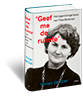
Thomas Rosenboom had never thought about children; as a writer, he led the life of a single person. The novel he had been working on for years just never got off the ground. But when he met his wife, life took a surprising turn. And there came not only a child, but also a book: Late... Late father.
Hearty Thomas Rosenboom opens the door of his Amsterdam upstairs flat in the heart of the city centre. His little daughter Anne is at daycare, his wife Blandine at work. And the writer is talking about his new book, Late father, a loving work about his fatherhood, love and age - how he is regularly mistaken for Anne's grandmother, for example, because of his petite stature.
Rosenboom, who turns 70 in January, met wife Blandine 10 years ago. They were 32 years apart in age, and yet it was a deep love from the start. And that changed his life radically: soon they got married and moved in together - another new experience -, he became a househusband and they had their daughter Anne.
On your 66e Becoming a father - that sometimes provokes strong reactions in the outside world. Rosenboom recounts an interview in The Gelderlander, three months after Anne was born. The article was accompanied by a picture of him as a proud father with his newborn on his lap. ‘I talked about that domestic fuss and fuss that comes with having a baby, very innocent all around, you might say. But it generated a lot of negative, even spiteful reactions.’
You have previously written thoroughly historical novels, not ego documents. So why now a work about your personal life?
‘That's right, in my fiction I have never even had a first-person narrator. This genre opened up for me when I wrote a rambling novel for Van Oorschot for the Terloops series. Ten years ago, I got stuck into a novel, which at the time I had been working on for about five years. It was to be a massive, ambitious work about the Amsterdam art world based on a true story about a Piet Mondrian canvas in the Stedelijk Museum. I had read a lot, plenty of material, a good plot development of a loner battling big institutions, and I also knew how I would tell it, with chapters alternating between present and past. Korton, a great story. But I got stranded.’
What happened?
‘I had a little room at the publishing house where I worked, and that gave me a foothold. But the publishing house moved to premises where there were no more writing rooms, so I had to work from home again. On top of that, my then relationship went out and I had medical problems. I just couldn't get back into that story. My editor tried to help me by meeting occasionally and getting me started with small assignments. But that didn't work. Writing started to bother me, just going to my study and turning on the computer became a huge barrier. I started looking up more and more to the appointments with the editor, because I felt embarrassed: I'm that guy who can't do it anymore.’
That sounds like classic writer's block. What did that do to you?
‘Funnily enough, I felt fine with it; I didn't feel hugely sorry myself that the book wasn't going to come out. I was at peace with it; I didn't necessarily need to make something more or outdo myself. I had worked hard for years and was reasonably satisfied with what that had produced. But then the question came whether I wanted to make that rambling booklet for Van Oorschot. And that came pretty easily to me. It wasn't a literary exercise; ordinary sentences were fine too. For me, it felt very relaxed. As a result, my fear of writing subsided and I also got used to writing in the first person. Later, the idea arose to make a small, unassuming book about my fatherhood in the same vein.’
What were the reactions of those around you when you got into a relationship with a woman 32 years younger?
‘I was welcomed very warmly into her family. No one reacted strangely to it. I didn't find it strange myself, because I did hang out with more people who were much younger or older than me. About a year and a half after we met, we got married. I had never wanted children, and we didn't talk about it then either. We started looking for a house together, but did not pay attention at all to whether it would be suitable for a child, whether there would be room for a nursery. Whether I would still be able to climb all those stairs here in 15 years’ time. I still felt young, going to the café. To my mind, I wasn't that much older than Blandine at all.'
Did you have to think twice when the subject of having children came up?
‘Blandine said she wanted a child quite badly, and because things were going so well between us, I thought it was great right away. Because I was so happy in love, I felt strong enough to take on that father role for the first time in my life.’
Was your age a topic of conversation in this regard?
‘We talked about it from time to time, but it was never an issue. What played a role in this was that Blandine lost her father in a traffic accident when she was 11 years old. She obviously grieved a lot for that, but at the same time, in her childhood, she never felt she had no father or that he gave her too little. She derived a lot of support from the beautiful memories she had of him. He was always with her, that's how it felt. And we are going to make sure of that too before I give up the ghost. Though I do hope to stay with Anne longer than until she is 11. She's 3 now, I'm almost 70. When I left home myself, I was 18 and didn't want to know much about my parents. In any case, I would like to give Anne a full upbringing. When she's 18, I'll be 85. That should be achievable, right?’
You never wanted children and now you are a full-time stay-at-home dad.
Rosenboom laughs. ‘Yes, but I was actually already a retired writer. I was already relieved of my ambition. If I had got her at my 30ste or 40ste I would have become very frustrated. I am more sincere in my interest in others than I used to be. Back then, I preferred only to talk about what I was working on because I was so full of it. Now I am all about attention and patience. I have become a nicer person. But that may be more because I stopped writing than because of my fatherhood.
The change to that domesticity, that family life, had already started when I met Blandine. From that moment we were together, I stopped going to the pub and going to bed late, smoking and later drinking wine. Thanks to my harmonious relationship, I was able to put that behind me.’
What's the best thing about being a father?
‘Playing is fun, but what I love most are the casual things. That she casually grabs my hand, looking not at me but down at the ground because she is busy with pebbles and leaves o the ground. Or that she slices bananas and gives me the thinnest and keeps the thick slices herself. Yes, then I really feel like a father.’
Prometheus, €22.99
Thomas Rosenboom (born 1956) made his debut in 1982 with the novella Bedenkingen (Objections). His first novel, Vriend van verdienste (Friend of Merit), was published in 1985. He won the Libris Literature Prize for his two subsequent novels Gewassen vlees (Washed Flesh, 1994) and Publieke werken (Public Works, 1999). In 2004, he was the author of the Book Week Gift with the novella Spitzen. The Red Carpet is the title of Rosenboom's latest novel, from 2012. His previous novella De grote ronde, a volume in the Terloops walking series, was published in 2020.


 Nederlands
  English (UK)
  Français