With the historical novel Cleopatra, British author Natasha Solomons wants to show a different, more vulnerable side of the famous queen and pharaoh. For she may have been the queen of the richest country in the world, but she was also a lover, mother and friend. ‘What makes us vulnerable as human beings is love, so through her love for her slave girl Charmian and her son Caesarion, I was able to show her warmth.’
Novels, historical books, plays, paintings, operas and films - the Egyptian ruler Cleopatra plays a (main) role in countless works of art. That did not stop British writer Natasha Solomons from choosing this icon as the main character for her new novel, called simply Cleopatra. Because even many centuries after Cleopatra's existence - she lived from 69 to 30 BC - the Egyptian monarch still captures the imagination.
What fascinated you so much about Cleopatra? Was there anything else for you as a writer to discover about her?
‘The Cleopatra as we know her is a version seen through the eyes of men: through the writings of historians such as Plutarchus and Cicero. It is historiography from the point of view of the Greeks and Romans, people who hated Cleopatra. Oriental historiography has its own sources and is mainly interested in Cleopatra as a politician and powerful monarch. But the Greeks and Romans mainly regarded her as a seductress.’
‘Shakespeare too relied mainly on Plutarch's accounts. In his play Julius Caesar, he omitted Cleopatra altogether, even though she was living in Rome at the time as his mistress and mother of his son. In his tragedy Antony and Cleopatra, Cleopatra is called a great and clever politician, but what she is mostly concerned with in that play is hanging out with her slaves and worrying about her age and whether her lover Mark Antony still likes her. Whereas sex in antiquity was a form of politics and power, and like the male rulers around her, Cleopatra made no distinction between them.’
She used sex as a political tool?
‘Indeed. But there was a crucial difference between princes and queens in ancient times: a male ruler could conceive as many as a thousand children, so to speak, without any danger to himself. A queen was not only very vulnerable during pregnancy, she was also at serious risk of dying in childbirth. So she had to weigh up whether the investment of having a ruler attached to her was worth that risk. For Cleopatra, that was the case with the two most powerful men in the Western world: Julius Caesar and Mark Antony. The perception that Cleopatra was a slut is absurd.’
Besides sex, murder was also an accepted political weapon.
‘ Yes, and to my mind she was completely comfortable with that. Having someone killed, I don't think she did it out of joy or pleasure, but she didn't, I think, sleep badly because of it either; it was just necessity, served a higher purpose. For example, if Cleopatra had not killed her brother Ptolemy, who was plotting a coup, she would have been killed by him. I don't think anyone at the time condemned her for that; it was perfectly logical for her to do so. As a contemporary writer, living in a world with a different morality, that is very far from me. But as a creator of a character from that time, I can understand her.’
You also emphatically show her as a mother and friend of her precious slave Charmian.
‘It was tightrope walking to find the right balance between her humanity and power. I was looking for the right balance between her self-awareness as a rightful heir to the throne on the one hand, a woman who has the right to rule and believes in her own power, and her humanity and vulnerability on the other. This is difficult with someone like Cleopatra, who considered herself - perfectly normal in her time - a goddess. For readers today, it is difficult to identify with that. I had to look for her humanity. What makes us vulnerable as human beings is love, so through her love for her slave girl Charmian and her son Caesarion, I was able to show her warmth.’
Were there sources on those sides of her life?
‘No, hardly at all. Fewer facts are known about Antiquity anyway, so that gave me a lot of freedom. Charmian is entirely made up: about her, apart from her name, we don't really know anything; she has dissolved into history. Cleopatra's slave Appolodorus is known to have been the one who brought her to Caesar. Whereas a historian would want to know whether she appeared before Caesar at that first meeting in rolled-up carpet or in a laundry bag, it was up to me as a writer to figure out what she might have felt at such decisive moments: what goes through a 19-year-old woman who has to seduce a ruler in his 50s to side with her in a war with her brother? Everything depends on that moment: her life, her kingdom. But she is also just a young woman who has never done anything like that before.’
Besides Cleopatra, there is a second narrator: Servilia. Who was she?
‘Servilia was really a surprise and I really enjoyed writing about her, because her story is the most dramatic, I think. Servilia was Caesar's mistress for decades; he loved her son Brutus as his own, but was murdered by him. Brutus is then on his mother's doorstep: “Mom, I'm in trouble, I killed your lover.” Servilia has to decide at that moment whether or not to help her son to keep the peace in Rome.’
‘She and Cleopatra are each other's mirror image. Cleopatra seems to have it all: she is queen and pharaoh, she rules the richest country in the world, she is on an equal footing with all those men in Rome. Servilia comes from a wealthy family in Rome, but her only job is to marry and produce children. At the same time, she seems to have more power in a certain way. Because as a young woman, at the age of 15, she already decides to love Caesar. They both marry, have children and other partners, and yet through it all they remain connected. She chooses to love him. That decision gives her a form of autonomy that Cleopatra never had, because for her every choice is political. So is her relationship with Caesar. To my mind, he is a different man with her than with Servilia. The dynamic between Caesar and Cleopatra is one of power and eroticism, but they are always on guard. Whereas, in my opinion, Servilia really cares about the man Caesar is, without ulterior motives. It's an honest relationship that lasts for decades - their love rivals the usually highly romanticised relationship between Mark Antony and Cleopatra.’
How much research have you actually done?
‘You obviously need a few pillars to hang the story on, but I did make choices. I read a few recent books about Cleopatra, especially the feminist ones. And I went to museums, like the British Museum, where they have an amazing pharaoh section, with public art: big statues that give you a sense of awe. And then there was the Petrie Museum of Egyptian Archaeology, which is part of University College London. An Indiana Jones-like museum where they have all kinds of household objects, like pots and wood to make your eyes on, combs and shoes, and the oldest preserved dress from antiquity. When I saw these items, I got a historical sensation: these objects, which were not much different from items on my own dressing table, women at that time used these items every day, their fingers touched them. I experienced closeness and intimacy.
Those amazing public images of rulers are designed to create distance and make you realise that rulers are not ordinary people. They are gods. But those domestic objects show that history is compressed, as it were. We are close to each other.’
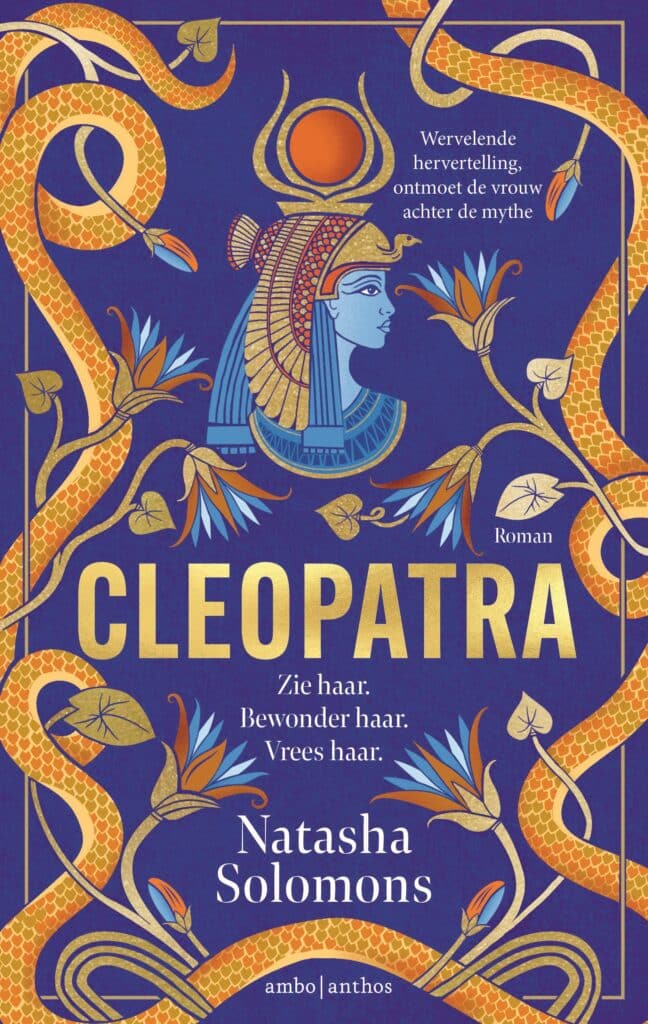
Translated from English by Marja Borg
Ambo Anthos, €23.99
British writer Natasha Solomons (b. 1980) made her debut in 2010 with Mr Rosenblum's List (translated into Dutch in 2011), based on the story of her Jewish grandmother and non-Jewish grandfather, who fled rising Nazism in Germany in the late 1930s and settled in England. Her successful debut was followed by eight more novels, including House of Gold, a family history based on the wealthy Rothschild family. In 2020, it was published in Dutch under the title The Goldbaum Dynasty. Besides novels, Solomons also writes screenplays, plays and articles for newspapers such as The Telegraph. Cleopatra is her tenth novel.



 Nederlands
  English (UK)
  Français