‘I never have something as simple as a sprained ankle. It's always immediately bloody serious: multiple sclerosis, a brain haemorrhage and now breast cancer.’ Publicist Karin Spaink underwent a mastectomy last spring. In September, when the chemotherapy is over, she plans to return to full working weeks. ‘Over the years, I have become stronger.’
'Oh God, here we go - That was the first thing I thought when I felt that bump. Can it stop now!? But on whom to get angry It was actually going a lot better for me. The MS has weakened in recent years and I also recovered well from that brain haemorrhage. We should do that trick again then, I told my parents. But sometimes I think: three times is the charm, it might not work this time.
Whether the MS has tamed itself or crawled into a corner, no idea. There is no obvious cause for my recovery. Good luck, I can't say otherwise. Over the years, I seem to have grown stronger. I noticed this when I evicted my friend Zenon in 2003. He was sitting at home without a job, not looking for something new and getting crankier and crankier. It became a fight. When he was gone, it felt like a liberation.
Self-confidence
My house was a smoky mess. I wanted to make it my own again and started by redecorating the bathroom. I ended up painting the whole house. Ten months it took me. Five minutes painting, ten minutes sitting. To my surprise, things gradually improved: I could paint for twenty minutes, sit for five. That gave me self-confidence. I thought: if I can do this, I can also try to work again. Of course, I was already writing columns for The Parool and gave lectures, but that was too little to live on. I realised: I'm 47, it's now or never.
On 1 April last year, I left the wao. I threw a big reintegration party. Ideally, I would have liked to be employed somewhere permanent, because then you can be sick again without it breaking you up immensely - after all, I still have MS. That didn't work out and so I started my own company. I now have a three-year assignment to produce a series of booklets on the internet and social changes we can expect in that area over the next 10 years. I am also writing a book on the history of computer magazine Hack-Tic and the Internet provider XS4all that evolved from it, but mainly on the social side of the Internet. It is such a pleasure to have a place where I can put my ideas back, but in the beginning I also found it scary to write for someone else. If it didn't turn out to be anything before, it was a waste of time and effort, but then I had only disappointed myself. I don't want to disappoint someone else. But things were going really well. I worked 55 hours a week and loved it.
Appearance
In April, my right breast was amputated. I was convinced that this would make me feel very unhappy. Friends said: you are the type to walk around without a prosthesis, you can do it. But I thought: you all think that, but I can't do it this time. I can't manage.
Appearance has always been very important to me. When I had to start using a wheelchair, I started dressing more extravagantly so that people looked at me first and only then at that wheelchair. I walked ramshackle, but it all looked good. Now the very thing that helped me - my appearance - was getting affected.
Until the very end, I thought I would not be able to do without a prosthesis. I wanted breast reconstruction right away. The night before the operation, I still wanted to leave the hospital. But when I came to - there was a big piece of plastic over my breast - I was so relieved it was gone. A photo was taken a few hours after the operation: I was sitting radiantly in bed with one breast and a scar.
Filling
A few days later, I got into a conversation with a man, a fellow patient. He sees it, I thought the whole time, and I felt very awkward. He asked why I was in hospital. When I explained that my breast had been removed, it turned out that he had not seen it at all. From then on, I never considered a prosthesis. Only some dresses look nicer with padding, I have yet to come up with something on that.
Much of my breast is still numb because all those nerves are cut. They took out a patch measuring 13 by 11 centimetres and 5.5 centimetres deep. Can you imagine? It doesn't feel physically mine yet, but the scar is starting to get used. My bald head does make me feel like an outsider, because you never see bald women. I only wear headgear against the sun and cold. I won't hide it.
The external change has not been too bad. Of course, my body was already ageing and I found that gulping at times, but you have to get used to it. For someone in their 30s, this is all much more intense, I think. Losing a breast is more difficult, the treatments make you menopause early, you have to think about whether you want children - and can still have them - and about death. Because of my MS, I had already thought about all that. That doesn't make it easier, but it's a smaller package all at once.
Far too soft
In our country it is always just about cardiovascular and lung cancer, but breast cancer is the most common cancer in the Netherlands and you hear much less about it. A thousand diagnoses a month! We need to start paying goddamn much better attention. I grew up in feminism, with books on get to know your body and so on. I knew how to do breast examinations, but I too thought the first time it would be nothing. I should have gone straight to the doctor. There are still so many women who don't check or don't know how to. A campaign like Pink Ribbon makes sense, but to my mind it is far too soft. There seem to be posters in Hunkemöller's fitting cubicles, but why not hang them in all fitting cubicles Show it more, with television spots for my part. This is also why I agreed to an interview at Nova, a few months ago. Only if we also talk about that social side, I said. Because it's pretty shitty for me, but I don't think that's a conversation in Nova worth.
GPs still far too often stick to the classic risk profile of women over 50. The internet site www.de-amazones.nl is full of stories of young women who have been sent home sometimes as many as three times. When they finally get to the hospital, it's too late. Those women are dying because that GP is blinded by the risk profile, they are dying because of statistics. GPs need to be made aware that breast cancer is a very important cause of death among young women.
I have the most aggressive form. After chemo, I will receive another year of immunotherapy and five years of hormone therapy. Despite that treatment, I can develop metastases in bones, liver and lungs. A year and a half after chemotherapy is the critical point. If you get through the first five years, chances are good that it will end well. The misery is: if you get metastases, you die. Full stop. They can try to stretch it and then the question is how far and for how long. You will have to set a limit at some point. I don't know where I put it when I get to that point. More than with MS, now I kept thinking I wouldn't be able to cope with things, when in reality they weren't that bad. My limit may be shifting further than I always thought.
Gypsy
Initially, I also thought I would hate being naked in front of someone again. That won't be so bad, I think now. I don't disguise it, so everyone can see that there's nothing left here. I haven't been with anyone since Zenon and I was fine with that; I was far too busy. In love, I'm a gypsy, I'm not one for long-term relationships. It's like with the subjects I write about. I can get all engrossed in them, but at some point I have said about them what I want to say and learned from them what I can learn. It's ultimately the same with my relationships. Lately, I've been looking around a bit more again. But the tricky thing is that someone I'm in a relationship with now has to face the fact that I might have metastases in two years' time.
I really miss having no one to hang out with at times. That's what a lover can do more than a friend, no matter how good. Saying, Spaink, keep your tater, now I'm just holding you for a while. With friends, I meet up when I feel relatively well. I have a strong tendency to stick up for myself and I think a sweetheart is more likely to see through that. I also allow them to see through it more easily.
Imploded
I don't know exactly where that grossness comes from. It's not out of fear of burdening people, because I don't feel that way with friends. I used to be afraid to say I couldn't make it because I thought I would completely collapse. I also couldn't argue with friends or loved ones; that's related to that. Once I was very angry with a boyfriend. I had a vision of myself: if I get angry now, I will spin through the room like a hurricane and destroy everything. That's not allowed, so I can't get angry. As if there was no middle ground. I then imploded, so to speak, completely locked inside myself.
Maybe it is fear of losing control. Again, I only cried once, after I got the results of the tissue examination. A friend brought me home, we had a drink, but only after he left did I sit and cry. For an hour, quite uncontrollably, the tears rolled down my cheeks. That period before the first chemo was difficult. I became hard, nothing interested me anymore, I was close to depression. That was because I didn't know what to expect. That chemotherapy was like an unknown mountain, where you don't know how high it is and how deep the valleys are. Now I can explore the terrain and hit stakes. I know: this happens, that doesn't, I have to watch out for that. I can think about it and that helps to give things a place.
Writing helps
That was another reason I started keeping a weblog, to show what it's like. For example, I don't know how to respond to compliments, they make me clumsy. People say: you still look good. That is very sweet and comforting, but I tend to then give a whole laundry list of my ailments. It's as if I'm indicating that someone shouldn't compliment me, but if I don't say anything, everyone thinks I'm not that bad. How do you get out of that?
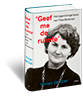
Writing helps me understand such things. Actually, at first I didn't want to write about it at all, I just felt like a patient. But it's what I'm good at: thinking about how illness works, both socially and individually, and writing about it. I recently started a column in Medical Contact. And I am going to write a book about it. It is planned for spring 2008.
I have been very tired lately, it is getting harder and harder. Working is difficult, but there is no sickness law. That scares me, even though I know I shouldn't worry about that now. I find it difficult to perform, my concentration is very poor. But if you allow yourself to go along with that, you sink much further. That's why I try to keep working. My history book is now on hold. I finish chemotherapy in September and hope to get back to a full working week after that. That book is coming, despite everything. I want it to. I promised.
Dear friends
If I heard I had metastases now, I might not even feel idiotically bad about it. I have had a nice life. Yes, I used to be bullied, had anorexia a long time ago and attempted suicide. When you put it all together like that, my life seems like a valley of tears. But that gives a false image, because then you leave out all the good things. The balance is very positive. I have treasured parents, dear friends and I have done all the things I thought were good and important. Because of MS, I always realised that I shouldn't put anything off because I might not be able to do it tomorrow.
I couldn't say what my life would have been like without MS. I don't believe a serious illness defines your character, at best it sharpens it. I have a certain tendency towards radicalism. But whether I would have been less outspoken if I hadn't fallen ill? I don't think so, I was before that. I am not a quiet person. In fact, I should lead a settled life; no smoking, no indulgences, go to bed on time. Then I would have a better chance of keeping the diseases quiet. But that is no guarantee and besides, I would have a life I don't like. Then die sooner if necessary. I am not cut out for a calm and quiet life’.’

 Nederlands
  English (UK)
  Français