In recent years, I have become fascinated by the question of what an artistic space actually is. Where is art truly free? Why is it so often accompanied by rules, prices and social conventions? When we visit a museum or gallery, we don't really make art, we consume it: we pay for a ticket and adhere to strict rules of behaviour. These spaces do not encourage people to make their own art, and they are not a full-fledged alternative to a mall, because they follow the same logic. So should we take art outside the museum?
One concept I found particularly useful to answer this question is Edward Soja's notion of “Thirdspace”. For Soja, space is not merely a physical container, but is also shaped by the meanings, narratives and power relations we project onto it. A factory and a museum may occupy the same building, but they are completely different spaces, because what defines them is not their walls, but what happens inside, and who decides about it. In Choosing the Margin as a Space of Radical Openness, a text often cited by Soja, bell hooks goes a step further and argues that spaces can be interrupted, appropriated and transformed through artistic and literary practices. From this perspective, space is never neutral: it is always a political choice.
Nowadays, the idea of repurposing spaces that previously had a different function is very popular. We often see this in art: exhibitions are now held in former factories, churches and various empty buildings. Not only public art, but also curated exhibitions in spaces far removed from official museums and galleries. What changes is what happens inside. However, many repurposed spaces are ultimately just manifestations of gentrification. I am sure everyone can think of a space in their city that has been gentrified: where the supposedly artistic venues are just posh places where a cocktail costs an unreasonable amount of money, and art is not even freely accessible because, as in any museum, you have to pay to enter or consume something. I think, for example, of NoLo, a neighbourhood in Milan that used to be home to mostly lower-income people, with affordable house prices. Today, the neighbourhood has become more expensive, with chic bars and restaurants moving in. The rezoning was never meant for the people who already lived there; no one asked them what amenities they needed. It was meant to make the neighbourhood attractive to wealthier residents, by creating more places to spend money.
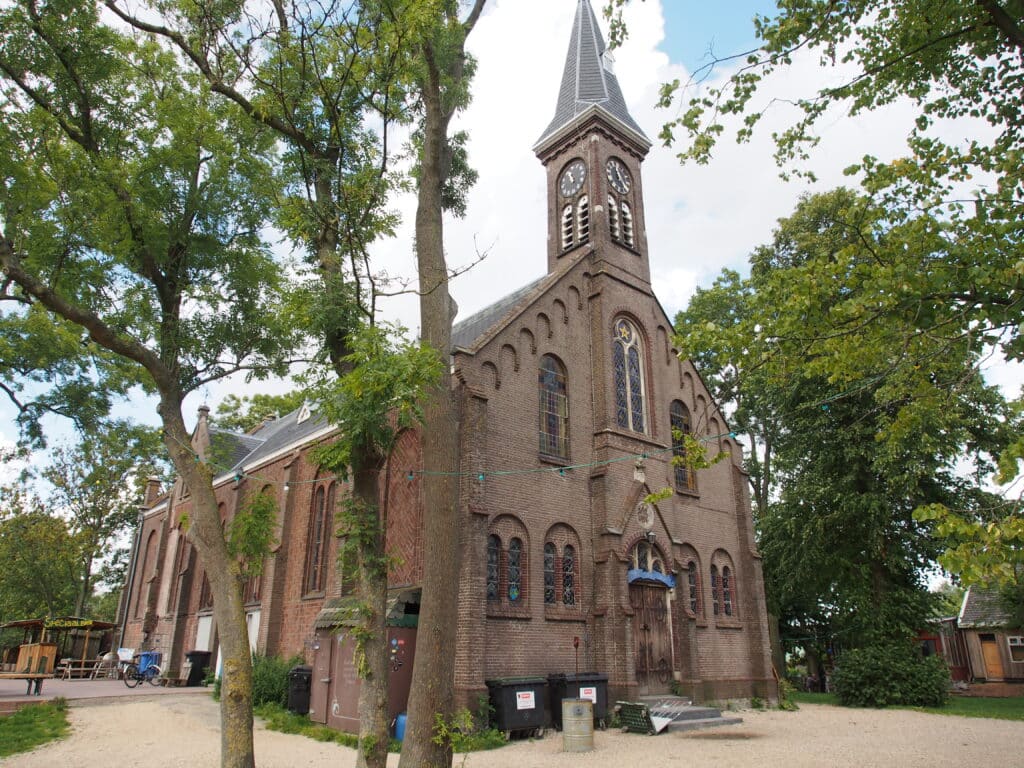
Yet there are spaces that genuinely strive for freedom and creativity, and I went in search of those spaces and what makes them so special. The first is Ruigoord, just outside the centre of Amsterdam, near the harbour. Ruigoord existed as a farming village for centuries before it was squatted in the 1960s by an artistic community; although it is no longer possible to live there, some artists still have their studios there. Ruigoord also organises festivals and is always open to the public. I believe it is what philosopher Hannah Arendt would call a “space of appearance”: a space defined by the act of collective creation, and one of the few places where art can truly exist freely. I was shown around Ruigoord by Roman, who grew up there, and he showed me the place and all the contradictions that come with it: in our conversation, he told me about local politics, with different factions and differing opinions on how the space should be managed, and about the extraordinary freedom given to children growing up there.
The second place is OostWest, located in Amersfoort's industrial area. Like Ruigoord, OostWest offers creative studios for artists, but also hosts DJ sets, workshops and courses; a space that is always open to visitors, which is exactly what I did when I visited. I got the chance to speak with Rob, one of the founders, and as he showed me around, both he and an artist working there explained the main strength of OostWest: that artists do not create in isolation, but can inspire each other and connect with the people who walk in. OostWest is not defined by its original function as an industrial container, but by what happens inside. This brings us back to the concept of Thirdspace: its ontological meaning determines the role of OostWest much more than its material appearance.
The main value of both Ruigoord and OostWest is undoubtedly their sense of community. There, art is not isolated, displayed behind glass on white walls. Art lives through contact between people, not consumerism and rules. Making art free, accessible and open to all is also a way of making the world more creative, and encouraging people to make art themselves, as a means of expression and freedom.
 Nederlands
  English (UK)
  Français