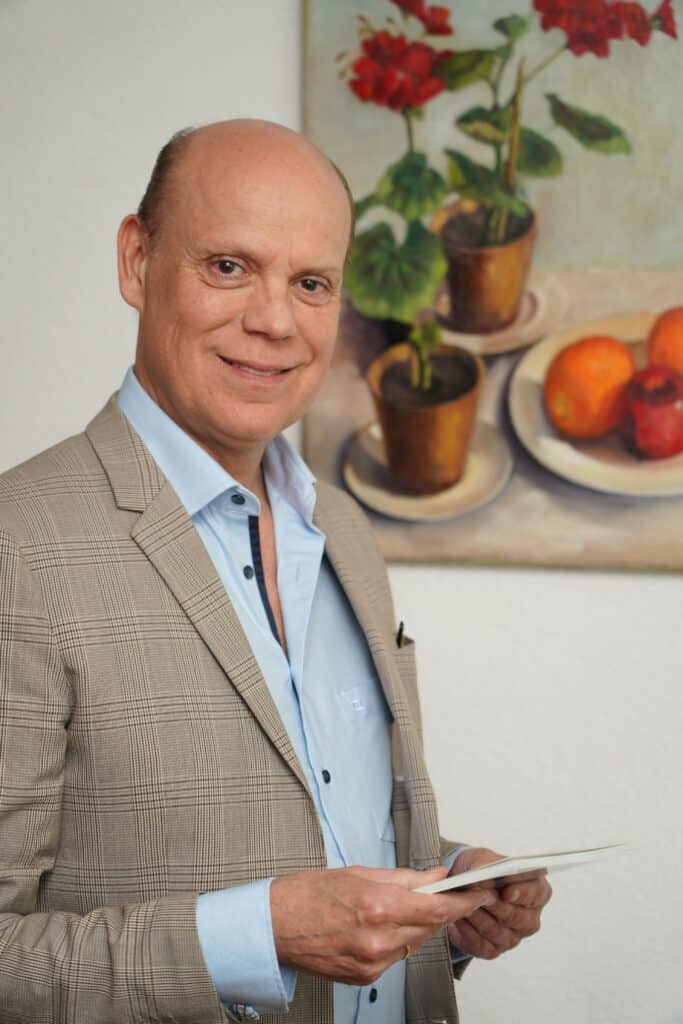
Dorine Schoon has been one of the leading advocates for fair pay for freelance musicians for many years. As a freelance oboist, she witnessed how musicians were underpaid, which led her to establish the Platform for Freelance Musicians eight years ago. Now that she is stepping down, she will continue to work as an advisor to improve working conditions for musicians and other creative professionals.
We are sitting at Dorine Schoon's kitchen table in Hilversum. Let's go back in time. What made her decide to set up the Platform for Freelance Musicians in 2018? ”I studied oboe at the Conservatory in The Hague,” she says enthusiastically. "There, I played a lot in ensembles, orchestras and musicals. At a certain point, I realised that you had to work very hard and for long hours to earn enough to live on. What's more, if you invested in something, such as setting up an ensemble, it hardly paid for itself."
Be happy
She worked for the Ballet Orchestra as a freelancer under the orchestra's collective labour agreement terms and conditions. ‘Even then, I had questions about it. How does that work? Why don't they just hire me? I discussed it with colleagues, but they weren't keen to answer. They just said, ’You should be happy you have a job. You have money now, and this is just what it pays.”"
She became increasingly interested in entrepreneurship in music. ‘On Facebook, a composer said that you should never work for free; he was really convinced of that. I then created a private group on Facebook, and that was the beginning of the Platform. No one dared to talk publicly about payments and contracts, but in this group they did. At first, it was just friends and colleagues who were members, but the group grew steadily. We talked about underpayment and financial agreements. What about an orchestra's collective labour agreement and what good is a trade union? This Facebook group turned out to be a hit, and freelance musicians enjoyed being able to talk about things that normally remained unspoken. It was truly a ’safe space”."
Concertgebouw
It was the beginning of the Platform for Freelance Musicians Foundation. Singer Caroline Cartens joined her. She knew her from the Hague Conservatory. ”She represented the freelance choir singers at the Dutch National Opera. We got in touch with the Arts Union and discussed with them the main issues musicians face. The platform grew larger and more serious. Then someone made a comment about the lunch concerts in the Concertgebouw, where musicians played for free. That story was picked up by a journalist from Trouw, and after that we received a lot of media attention. In particular, the structural underpayment of musicians was exposed. The Concertgebouw audience was not aware of this either."
Young musicians and music students are told by music programmers that performing for free or for a minimal expense allowance is good for their career and that they need to gain experience. After all, you are being offered a stage that generates a lot of attention and you can add that to your CV.
Fair Payment
Fortunately, fair payment for musicians and other performers in the arts has become an integral part of the Fair Practice Code. ”Fair payment has become more negotiable. Everyone knows more or less what the Fair Practice Code is. It is also mandatory to adhere to this code if you want to receive government subsidies as an organisation. Do unsubsidised music organisations also adhere to this code? No. And that is a big problem. As a freelancer with the major BIS orchestras, you now get paid the same as someone in permanent employment, which was not the case before. I should add that the latter is due to the introduction of the Balanced Labour Market Act (WAB). We did have to keep a close eye on the orchestras to ensure they applied this law."
Hoboklas
Ignorance and fear prevent musicians from asking for more money for a performance or concert. ”I was at the conservatory and we played Bach cantatas every month for a music organisation in Westland. It was very poorly paid. I said to the oboe class: shall we all ask for more, so that we don't play for less than a certain amount? My fellow students didn't want to. They were afraid they would lose their regular gig."
According to Schoon, students at the conservatory do not learn how to negotiate a fee for their performances. ”Many musicians believe that music organisations do not have any money and therefore cannot pay musicians properly. We have also come to believe this, but we must stop doing so. You can decide together to speak up when something is not right."
Schoon is now discontinuing the Platform for Freelance Musicians. She has provided musicians with the tools and highlighted the issue of structural underpayment. Now it is up to them to take action. ”Our greatest achievement is that creators were able to participate in policy discussions. And that people weren't just talking about us. That has brought about a shift. You're no longer laughed at when you bring up fair payment. That it's a matter of decency that you are paid well. That many issues are no longer left unspoken."
Balance of power
More and more colleagues are also daring to speak out about social security in the classical music world. Unfortunately, however, undesirable behaviour and job insecurity are still commonplace. ‘It also has to do with the power relations within the classical music world. You don't argue with a conductor or leader. Because as a freelancer, you won't be asked back. The pattern of ’I'd better not say anything” is still not being broken. There is a culture of fear, fear of losing out, of not getting any more work. As a musician, you can't make mistakes, because you can't put them right."
When asked what she learned from setting up the platform, she thinks for a long time. ’I was more involved in it than was healthy for me. It kept me awake at night. You feel responsible. Also because you can't solve everything. Would I have done things differently? I should have been clearer and more outspoken. I was too cautious; that's just the way I am.”
Schoon now works as a consultant, coach and educator on Fair Payment. What advice does she give to aspiring musicians? ”Believe in yourself! Believe in your worth and don't belittle it. Anything you don't know, you can now find help with more easily. Don't muddle through on your own. You don't have to reinvent the wheel, which is why I continue to pass on the knowledge I have gained with the platform."
ballet orchestra
Her commitment to PVFM has resulted in her losing all her work as an oboist. She does not discuss this much. ”I worked freelance for the Ballet Orchestra for fifteen years and, without any explanation, I was no longer required to play. It was during the coronavirus pandemic, and you start to wonder about all sorts of things. Out of interest, I decided to take the matter to court. In the meantime, I was already appearing in the newspapers. I knew then that I would no longer be asked to play for orchestras. You don't want to be part of a system that you yourself oppose.” I found it very sad that I was never called again by colleagues from the Ballet Orchestra. That no one ever contacted me again, even though I had enjoyed playing there for fifteen years? Solidarity in music is something I really miss.”
She was still asked to perform at concerts, but she often declined. She found preparing for and performing at top-level concerts to be very stressful. ”Playing the oboe is also physically demanding. You have to practise every day. If you want to perform at the highest level, you have to be able to keep playing at that level. I am still sometimes introduced at gatherings as an oboist, but I no longer perform on stage. And now? I now earn more from giving advice and workshops on Fair Payment than I did when I worked as an oboist in an orchestra." She says she misses the pleasure of playing, but not the constant search for work.
For the future, Schoon hopes that a socially safe workplace and fair pay for work done will be a matter of course. ”That we no longer have to talk about it. I hope that the new generation of musicians will speak up more easily and that they won't take everything for granted. And that they will continue to fight for their interests!"
Appreciate this Article!!!
Culture Press is independent. You make that possible with a donation to the author of this article. We will transfer your donation for 100% to the author!
Appreciate this Article!!!
Culture Press is independent. You make that possible with a donation to the author of this article. We will transfer your donation for 100% to the author!

 Nederlands
  English (UK)
  Français