When a judge considers.
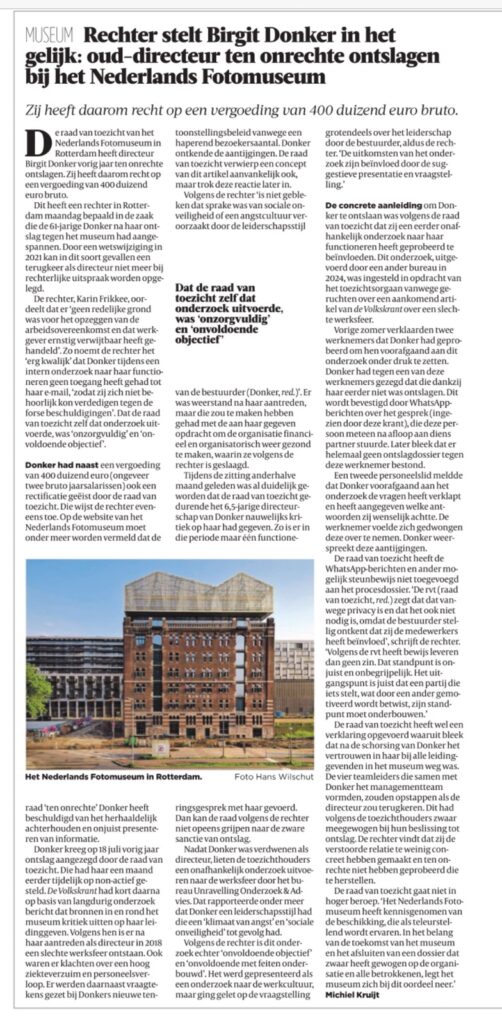
The article about the court's ruling, which is also damning for the Volkskrant, was written by the same reporter who previously wrote an article that caused this trouble. An article, according to the Council for Journalism, that was poorly substantiated (but indeed ‘balanced’), based on accounts from two former employees of the Photography Museum. The reporter has now, in reporting the court's decision, pressed the quotation mark button so many times that even Wierd Duk, specialist in that genre, would be ashamed of it.
‘We know better’
But with quotation marks used in such a great quantity, you cast doubt on every statement: “it's the judge who thinks this, she'll have her reasons, but we know better.” This becomes explicit when it concerns app-based communication in which the director, who was completely vindicated, allegedly behaved in an inappropriate manner. De Volkskrant reported on this in a rather flimsy follow-up, but no one produced screenshots as proof.
If there is no proof, it didn't happen, but the Volkskrant is now factually reopening the case, by stating that the newspaper has seen that proof. That seems legally problematic, to say the least, because then you'll have to demonstrate that. The fact that the newspaper does not do that, but only repeats the accusation and thus completely questions the judge's verdict, is stupid, but also very bad for trust in the rule of law. That is much worse.
Hardened old man
The entire article could be dismissed as the work of a ‘boresome old man’ feeling put out, but this is going too far: when you call the judiciary into question to such an extent, and thereby still discredit the party that won their case, a defamation charge is certainly something to consider. For the party that was discredited.
What the Volkskrant is now also doing is undermining trust in journalism. When a journalist is deceived by their sources, they have no story and must face the consequences. It happens to the best, and it often happens that you are exploited by people with their own agenda. That is painful, but it also makes you better, more careful, and more reliable. So be it, less sensation, but society benefits.
4 tonnes?!
The question remains whether the compensation of £400,000 for the dismissed director will not lead to invidious comparisons. If that is indeed two gross annual salaries, director Donker, with the approval of the Supervisory Board that was proven wrong, was well above the norm, in a sector that is already struggling. Even if we deduct half a ton for legal costs. For example, it is twenty times the gross annual turnover of this culture correspondent.
Correction 30-06-26, 16:29
However, it is now clear that this amounts to two annual salaries of just under £150,000, plus legal costs of over £100,000. Both figures are more in line with what is customary in the sector.
Read more here about: A cap on top incomes?
Naturally, we want Birgit Donker to receive compensation, but then the conversation about the enormous income disparities in the cultural sector must be had. And, incidentally, not just in the cultural sector. Because the fact that even with an income of £200,000 per year you can still be laughed at by the CEOs of companies you approach for sponsorship is painful enough.
Read our previous reporting on the Donker case here: https://cultureelpersbureau.nl/?s=birgit%20donker




 Nederlands
  English (UK)
  Français